
High-density polyethylene (HDPE) piping is the preferred material for buried utilities in Dubai due to its flexibility, corrosion resistance, and joint reliability when installed correctly. However, in the emirate’s operating conditions surface temperatures reaching 50–60 °C, intense solar UV radiation, thermal expansion/contraction cycles, shifting dune sands, and occasional third-party mechanical damage HDPE systems remain vulnerable to specific failure modes: fusion joint separation from inadequate welding parameters, slow leakage at fittings due to poor alignment or scraping, pinhole stress cracking from ground movement or point loads, and sudden bursts from over-pressure or external impact.
Our methodology strictly follows ISO 4427 (PE pipe systems), AWWA C906 (polyethylene pressure pipe), and Dubai Municipality water supply codes. Detection utilizes acoustic correlators with multi-sensor arrays for ±0.3 m accuracy, pressure wave transient loggers to identify anomalies, and ground-penetrating radar to locate associated soil voids or water pockets. Invasive confirmation is performed via small-access vacuum excavation pits to avoid secondary damage.
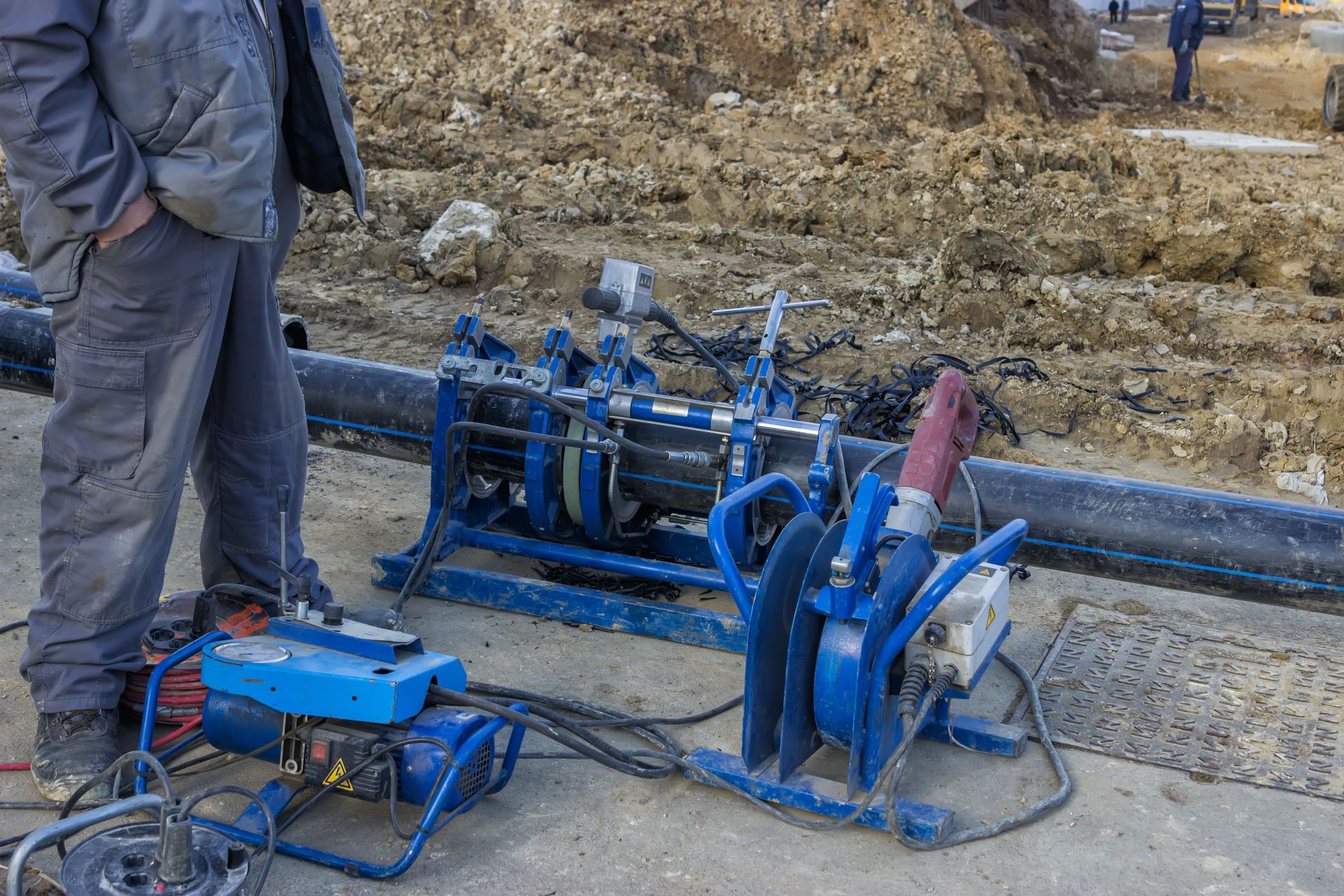
Repair techniques are selected based on defect severity and operational constraints: full section replacement (cut-out of 1–3 m defective length, insertion of new PE100 segment using electrofusion couplers for rapid, high-integrity joints), saddle fusion for service connections, external repair clamps (temporary or permanent), pipe bursting for collapsed or severely degraded sections, and slip lining where full excavation is restricted. Fusion parameters are rigorously controlled and logged: surface scraping to virgin material, alignment offset limited to <10%, heater plate temperature/pressure/time per ISO 21307 traceable certificates.
Testing comprises hydrostatic pressure hold at 1.5× design working pressure for 2 hours with no allowable drop exceeding 2%, supplemented by pneumatic testing where hydrostatic methods are impractical. Potable lines receive chlorination dosing and laboratory sampling per DM requirements. Backfill is compacted in 200 mm layers to 95% modified Proctor density, with protective sleeves installed where abrasion risk persists.
UAE-specific challenges are systematically addressed. Heat derating reduces design pressure by 20–30% at elevated service temperatures; protective measures include white or reflective coatings and shade structures during welding. Coastal salinity mandates PE100-RC grades with enhanced slow crack growth resistance. Shutdowns for mains exceeding 160 mm require DEWA NOC and are scheduled for night hours to minimize customer impact.
Performance metrics include average repair completion for 200 mm HDPE mains within 8–24 hours, zero documented joint failures post-repair over five years, and avoidance of cumulative water loss penalties and escalation costs exceeding AED 100,000 per incident.
Variations encompass repairs on large-diameter mains (>630 mm), live saddle fusion for branch connections without full isolation, trenchless rehabilitation via CIPP or fold-and-form methods, and emergency burst response with rapid mobilization.
In conclusion, HDPE leak rectification in Dubai is a precision, high-consequence discipline requiring advanced detection, qualified fusion techniques, verifiable pressure testing, and strict environmental controls to restore system integrity and prevent recurrence. Our multi-detection redundancy, data-logged welding traceability, rapid authority coordination, and 24/7 emergency capability ensure durable, compliant repairs that protect water resources, infrastructure assets, and operational continuity in one of the region’s most demanding utility environments.


