
Self-leveling flooring systems are essential for operational efficiency and safety in Best’s industrial, logistics, commercial, and showroom environments. Uneven substrates cause vibration-induced equipment wear, product damage during handling, safety incidents (forklift tip-overs, slips), dust generation in controlled atmospheres, premature coating failure, and non-compliance with ISO or third-party audits. Substrates vary widely: old warehouse slabs with laitance, oil contamination, cracking, or patching; new pours with surface laitance or curling; and areas subject to chemical attack, heavy point loads, or thermal cycling.
Our systems comply with EN 13813 (resin and cementitious screeds), BS 8204 (screeds), and project-specific performance specifications. Preparation removes laitance, oils, and weak surface layers via shot-blasting or planetary grinding to CSP 3–5 profile. Cracks and construction joints are treated with low-viscosity epoxy fillers or flexible sealants. Moisture mitigation includes vapor barriers or epoxy primers where emission rates exceed thresholds. Priming uses low-viscosity epoxy sealers to promote adhesion and prevent outgassing.
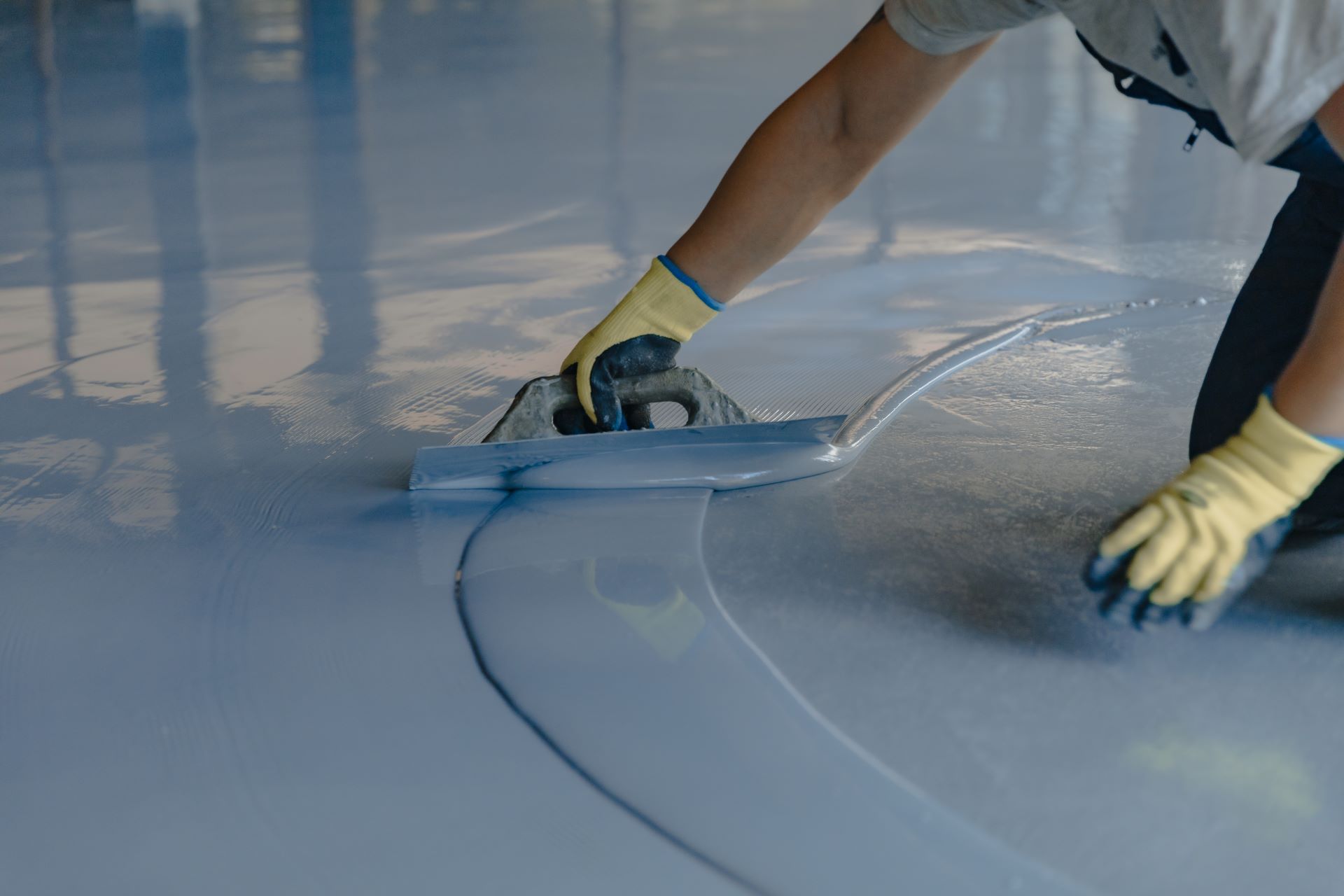
Self-leveling application involves mixing to precise flow consistency, pouring in continuous ribbons, spreading with gauge rakes or smoothing trowels, and de-aeration with spiked rollers to eliminate pinholes. Thickness ranges from 1–3 mm for thin cosmetic/self-leveling overlays in showrooms to 3–50 mm for heavy-duty cementitious underlays in industrial settings. Multiple layers are applied where deeper correction is required.
Topcoat systems include solvent-free epoxy base coats (pigmented, high-build), elastic polyurethane finish coats for abrasion and chemical resistance, and optional quartz or silicon carbide broadcast for enhanced texture and wear resistance. Curing is controlled with environmental monitoring (dehumidifiers and heaters in summer), allowing 24–48 hours light traffic and 7 days full chemical resistance.
Testing confirms performance: surface regularity (SR1–SR2 per TR34 or <3 mm over 3 m), compressive/flexural strength, pull-off adhesion (>2 MPa), slip resistance (pendulum test), and abrasion resistance (Taber abrader CS17 wheels). All results are documented with traceable calibration records.
No 1-specific challenges are systematically managed. High summer temperatures necessitate chilled mixing water, night pours, and retarder admixtures. Humidity is countered with fast-cure formulations and dehumidification. Heavy forklift loads (5–20 tons) require reinforced compounds and proper joint detailing. Downtime is minimized through weekend/overnight works and rapid-cure options.
Quantifiable outcomes include typical 5,000 m² warehouse leveling and coating completed in 4–7 days, flatness consistently achieving <3 mm over 3 m, service life exceeding 10 years, and avoidance of AED 300,000+ in accident claims, equipment damage, and premature recoating costs.
Variations include thin-film self-leveling (1–3 mm) for retail/showroom aesthetics, thick underlay + resin topcoat for industrial heavy traffic, ESD/anti-static systems for electronics or powder-handling areas, and rapid-set formulations for 4–6 hour return-to-service.
In conclusion, self-leveling floor painting in Best is a performance-critical application where substrate preparation, flow control, coating chemistry, and rigorous testing directly determine flatness, durability, safety, and operational efficiency. Our disciplined execution, certified materials, comprehensive verification, and minimized-downtime scheduling deliver dead-flat, long-lasting floors that support productivity and compliance in one of the region’s most demanding industrial and commercial environments.


