
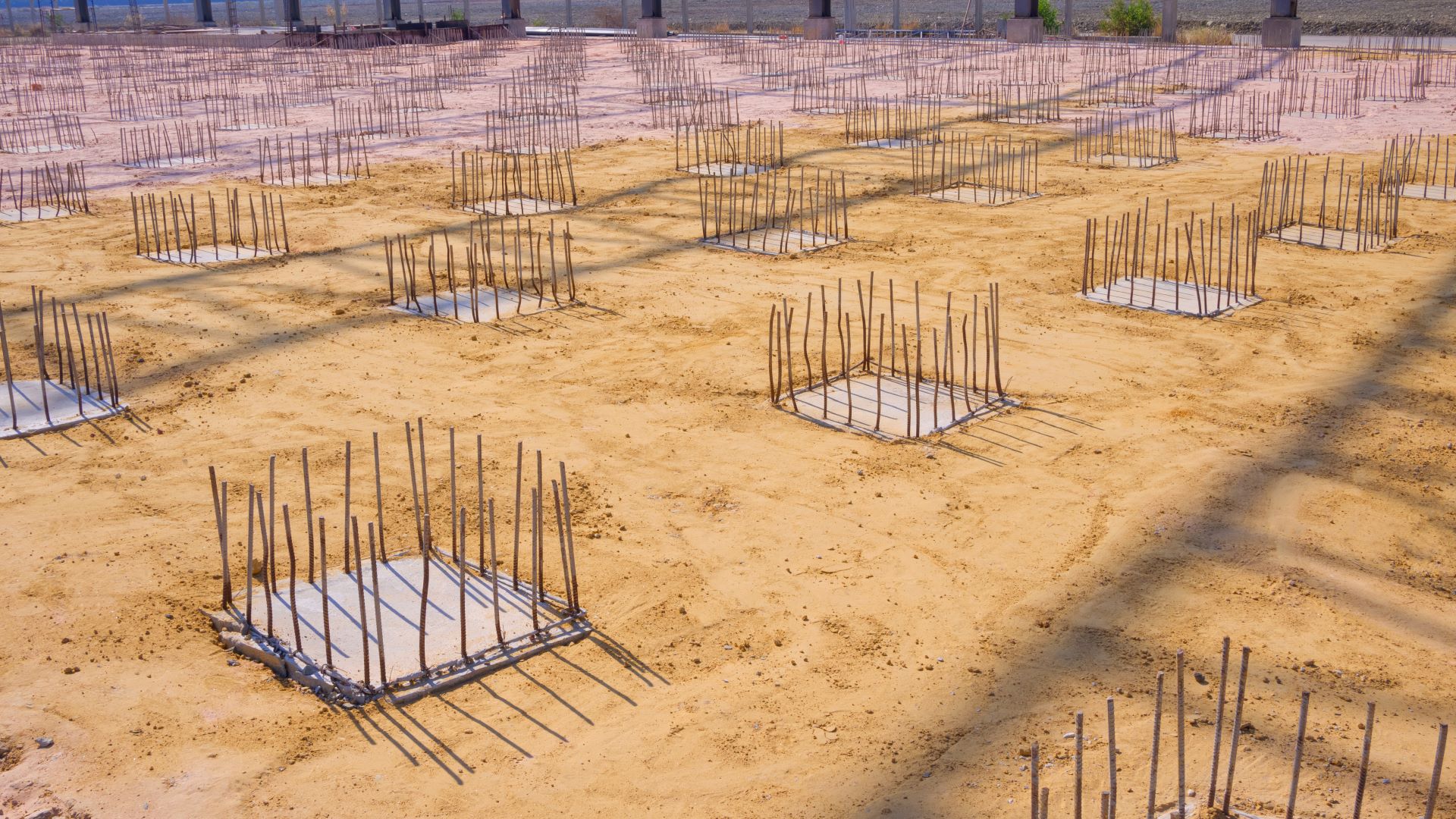
Foundations in Dubai serve as the critical interface between superstructure loads and highly variable subsurface conditions. Soils range from loose dune sand (SP classification, bearing capacity 50–150 kPa) to sabkha with high soluble salts and collapsibility, marine clays, weak limestone, and engineered fill on reclaimed land. Groundwater tables fluctuate between 1–6 meters, introducing buoyancy, corrosion, and excavation challenges. Seismic design per Dubai Building Code amendments (Zone 2B) requires ductility detailing in accordance with UBC 97 principles.
Our methodology commences with detailed evaluation of borehole logs, standard penetration tests (SPT), cone penetration tests (CPT), and plate load tests where required. Foundation type selection balances load distribution, soil bearing capacity, and settlement criteria: shallow systems (isolated pads, strip footings, combined footings, or solid/ribbed rafts) for uniform loading above 200 kPa on competent ground; deep foundations (driven precast concrete piles, steel H-piles, cast-in-situ bored piles 300–1500 mm diameter to 10–40 m depth, barrettes, or CFA piles) in weak or variable strata. Ground improvement techniques (vibro stone columns, dynamic compaction, or permeation grouting) are employed where shallow foundations are feasible but settlement must be further controlled.
Execution includes founding-level inspection via probe pits, 75–150 mm PCC blinding, prefabricated reinforcement cages with epoxy coating in saline splash zones, formwork installation (timber, steel, or aluminium), concrete placement under strict slump and temperature control (maximum 32 °C pour temperature), and 7-day wet curing using hessian or membrane compounds. High-strength mixes (C30–C60) incorporate admixtures for workability in high ambient temperatures.
Testing is exhaustive: 7- and 28-day cube compressive strength (minimum 95% characteristic value), non-destructive pile integrity testing (sonic echo and cross-hole sonic logging), static load tests to 1.5–2.0 times working load, and dynamic/statnamic testing where appropriate. Settlement monitoring plates and magnetic extensometers provide post-construction verification, typically recording total settlement below 10 mm in most cases.
Compliance encompasses Dubai Municipality structural submission requirements (stamped calculations and drawings), geotechnical report NOCs, witnessed pile load tests by approved laboratories, and as-built records for handover. Corrosion protection measures include minimum 50 mm cover, SRC cement, and epoxy-coated reinforcement in aggressive environments.
Challenges specific to the UAE are systematically addressed. Collapsible soils are pre-wetted or replaced. High groundwater is managed via sheet-pile cofferdams and recharge wells. Heat effects are countered through night pours, ice-chilled mixing water, and retarder admixtures. Over-design is avoided via finite element analysis (PLAXIS, SAFE) yielding 10–20% material savings without compromising performance.
Quantifiable outcomes include completion of typical 20-story tower raft foundations in 6–8 weeks, pile load tests consistently exceeding design capacity by 50–100%, and settlement monitoring demonstrating compliance with stringent limits. These results prevent rectification costs commonly ranging from AED 5–20 million in projects with inadequate foundations.
Variations include rafts on vibro-compacted or stone-column improved ground, micropiles for restricted-access sites, underpinning for adjacent structures, and top-down construction sequences for deep basements with permanent propping.
In conclusion, foundation design and construction in Dubai is a high-consequence discipline where geotechnical uncertainty, regulatory scrutiny, and environmental aggression demand uncompromising engineering discipline. Our integrated approach—combining in-house design review, advanced testing capabilities, proactive authority submissions, and a proven track record—delivers engineered certainty, accelerated timelines, and long-term structural integrity in one of the most geotechnically challenging construction markets globally.


