
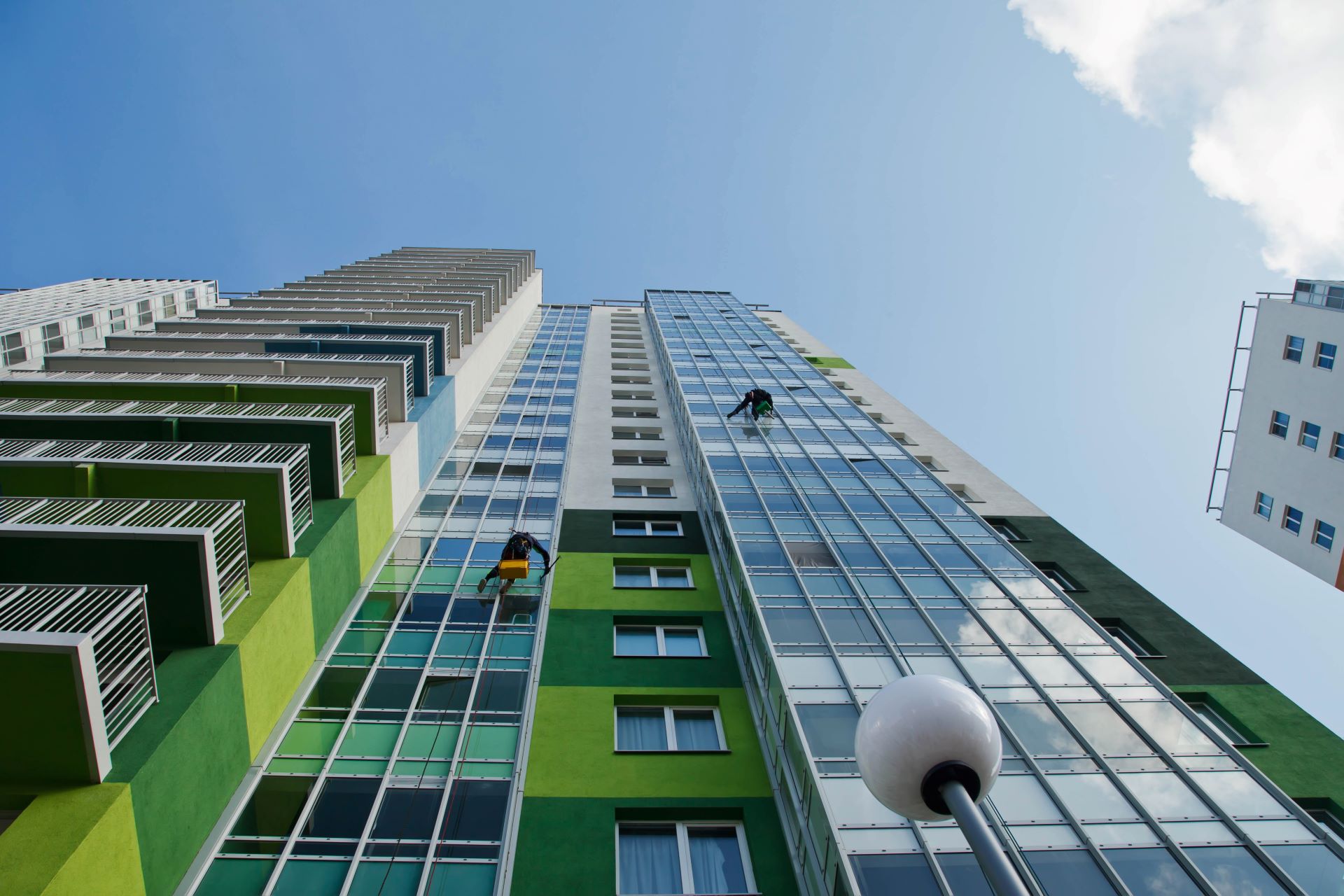
High-rise facade painting in Best is a vertical, high-exposure maintenance and protection discipline where coating performance directly influences building aesthetics, energy consumption, structural longevity, public safety, and regulatory compliance. Towers and tall structures face relentless degradation from peak solar radiation (>3000 kWh/m²/year), surface temperatures of 50–70 °C, nightly cooling contraction, salt-laden winds causing efflorescence and pitting, sand abrasion, carbonation (CO₂ diffusion attacking concrete alkalinity and exposing rebar), water penetration during rare storms, and wind-driven pollutants. Untreated or poorly applied coatings blister, crack, delaminate, fade to dull tones, chalk, allow progressive carbonation (increasing rebar corrosion risk), permit moisture ingress leading to mold and spalling, and generate falling debris hazards triggering DM safety orders and public liability claims.
Our systems comply with BS EN 1504 (products for concrete protection), ASTM C1184 (elastomeric coatings), and Best Municipality facade maintenance guidelines. Planning includes drone or roped-access inspection, infrared thermography for moisture mapping, phenolphthalein testing for carbonation depth, color scheme approval (RTA/DM for street visibility), and wind/safety calculations for access equipment (BS 5973 scaffolding standards).
Preparation removes loose material, efflorescence, and salts via 3000 psi pressure washing, mechanical abrasion to SA 2.5 profile where required, crack injection (>0.2 mm) with low-viscosity epoxy, and spall repair using polymer-modified mortar. Priming applies alkali-resistant penetrating sealers to stabilize the substrate and prevent saponification.
Coating application includes elastomeric intermediate coats (150–250 microns per layer, crack-bridging up to 0.3 mm) and aliphatic polyurethane or silicone topcoats (total DFT 300–500 microns) with high solar reflectance (SRI >80–100) for heat rejection. Airless spraying ensures uniform coverage, with roller application for detailing. Exposed areas receive additional UV-stable clear coats where necessary. Access utilizes building maintenance units (BMU), swing stages (wind-stabilized), or abseiling for localized repairs, with phased quadrant execution to maintain occupancy.
Testing verifies dry-film thickness (±10% uniformity), adhesion (ASTM D4541 >1.5 MPa), gloss (60° angle per ASTM D523), color consistency (delta E <2), and accelerated weathering (QUV >2000 hours no chalking or cracking).
No 1-specific challenges are systematically managed. Coastal salt requires higher DFT and marine-grade formulations. High wind necessitates enclosed scaffolding or night works. Heat gain is countered with reflective pigments and early-morning application. Occupied buildings demand tenant notifications, full window/AC unit masking, and minimal VOC systems (<50 g/L).
Quantifiable performance includes typical 50-story tower (20,000 m²) painted in 20–40 days (phased), cooling load reductions of 15–25% post-application, 10–15 year warranted fade-free performance, and avoidance of AED 2 million+ in structural repairs from progressive carbonation.
Variations include anti-graffiti coatings, textured or metallic finishes, pearlescent effects, retrofits over existing paint, internal atrium painting, and low-embodied-carbon formulations for green certifications.
In conclusion, high-rise facade painting in Best is a safety-critical, performance-driven envelope intervention where preparation rigor, coating chemistry, application control, and testing directly determine long-term weather resistance, energy efficiency, structural protection, and visual quality. Our systematic approach combining drone-assisted diagnostics, elastomeric anti-carbonation systems, reflective topcoats, phased high-access execution, and comprehensive verification delivers refreshed, compliant, and durable facades that enhance value and safety in one of the world’s tallest and most exposed urban skylines.


