
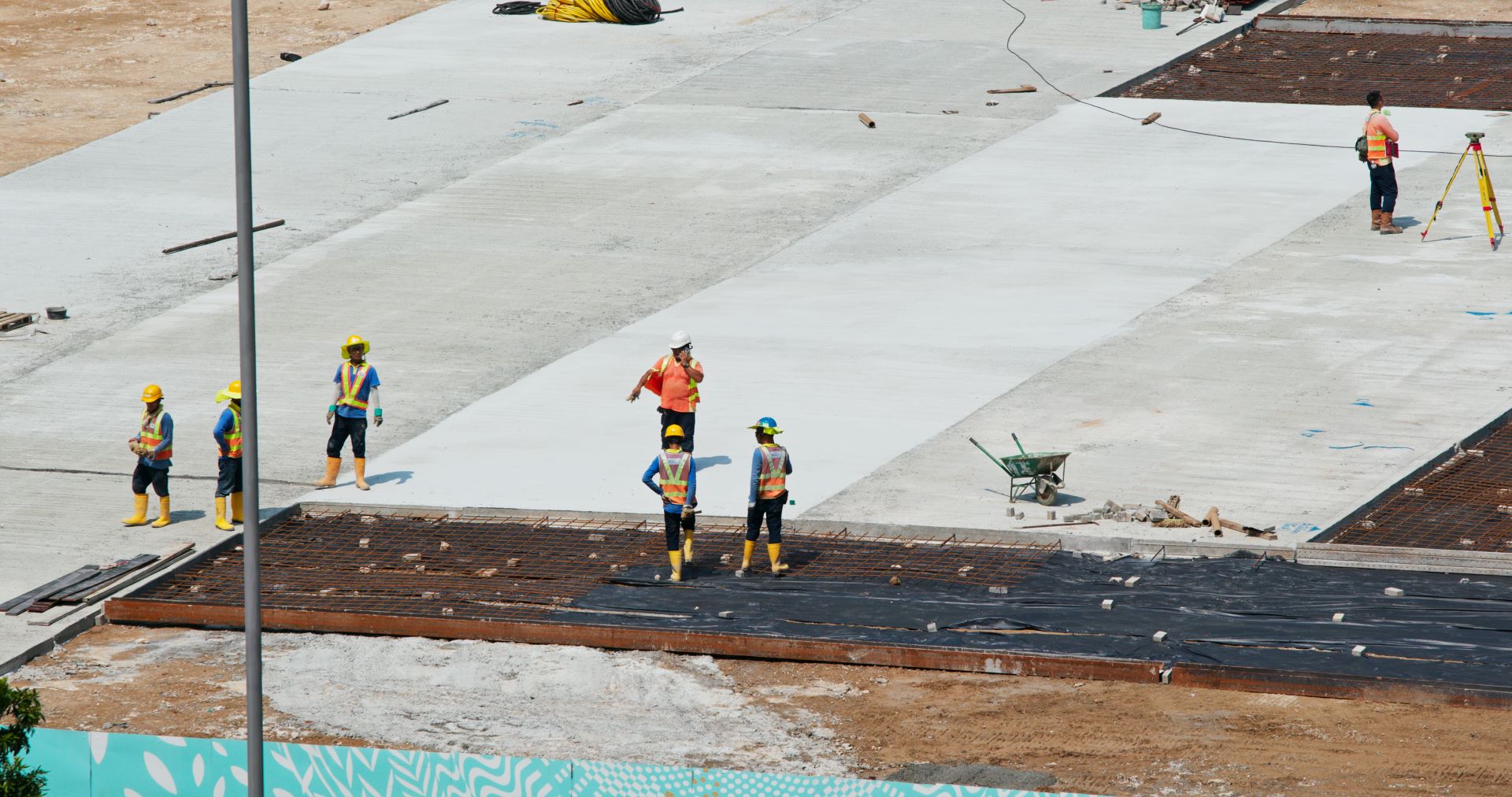
Plain Cement Concrete (PCC) serves as the critical, non-reinforced supporting layer in virtually every construction project in Dubai, functioning as blinding under foundations and rafts, sub-base for roads and pavements, lean concrete bedding for pipes and trenches, mass fill for voids and leveling, and working platforms for heavy equipment. In the UAE’s harsh environment ambient temperatures frequently exceeding 45 °C during placement, high humidity in coastal areas, aggressive groundwater with elevated sulfates and chlorides, and variable local aggregate quality any compromise in mix design, batching accuracy, placement technique, or curing regime can result in early-age cracking, reduced durability, settlement of overlying structures, and rectification costs that escalate rapidly.
Our methodology adheres to BS EN 206, Dubai Municipality Concrete Code, and project-specific geotechnical recommendations. Mix design commences with laboratory trials targeting characteristic strength plus margin (e.g., 20 MPa nominal → 28–32 MPa target), durability classification appropriate to exposure conditions (XC4/XS3 for saline groundwater per EN 206), and workability suitable for hot-weather placement. Aggregates are selected for specific gravity 2.6–2.8, low absorption, and compliance with chloride/sulfate limits per DM tables. Cement is SRC in sulfate-aggressive zones, with supplementary cementitious materials (fly ash or GGBFS) incorporated to reduce heat of hydration and improve long-term durability.
Batching occurs at central plants or calibrated site mixers with accuracy of ±2%. Slump is strictly controlled (rejecting loads outside 75–150 mm), placement proceeds in layers not exceeding 300 mm, and full compaction eliminates voids. Large areas incorporate saw-cut contraction joints to manage shrinkage. Curing is mandatory for a minimum of 7 days using wet hessian, ponding, or high-efficiency membrane compounds retaining at least 90% moisture.
Testing follows a rigorous protocol: three cubes per 50 m³ or shift, 7-day interim checks, 28-day compliance crushing, and core extraction if disputes arise. Chloride and sulfate content are verified per DM requirements, with rejection criteria strictly enforced.
UAE-specific challenges are proactively managed. Aggregate variability is countered through supplier audits and stockpile testing. Rapid set in high temperatures is mitigated with retarders and night pours. Honeycombing is prevented through operator training, supervision, and vibration monitoring. Over-design waste is avoided via optimized mix proportions, yielding 10–15% cement savings without compromising performance.
Quantifiable outcomes include completion of typical 5,000 m² blinding or sub-base layers in 5–7 days, 28-day strengths consistently achieving 105–120% of target, and avoidance of AED 1–5 million in settlement or pavement rectification costs commonly seen in projects with substandard bases.
Variations encompass blinding under foundations and rafts, road sub-base preparation, lean concrete bedding for pipelines and trenches, mass concrete fill for large voids or leveling platforms, and structural blinding for temporary working surfaces.
In conclusion, PCC in Dubai is a foundational element whose quality directly influences the performance and longevity of overlying structures. Our disciplined approach combining laboratory-controlled mix design, calibrated batching, hot-weather placement techniques, extended curing, and comprehensive testing ensures consistent strength, durability, and compliance in one of the most aggressive construction environments globally.


